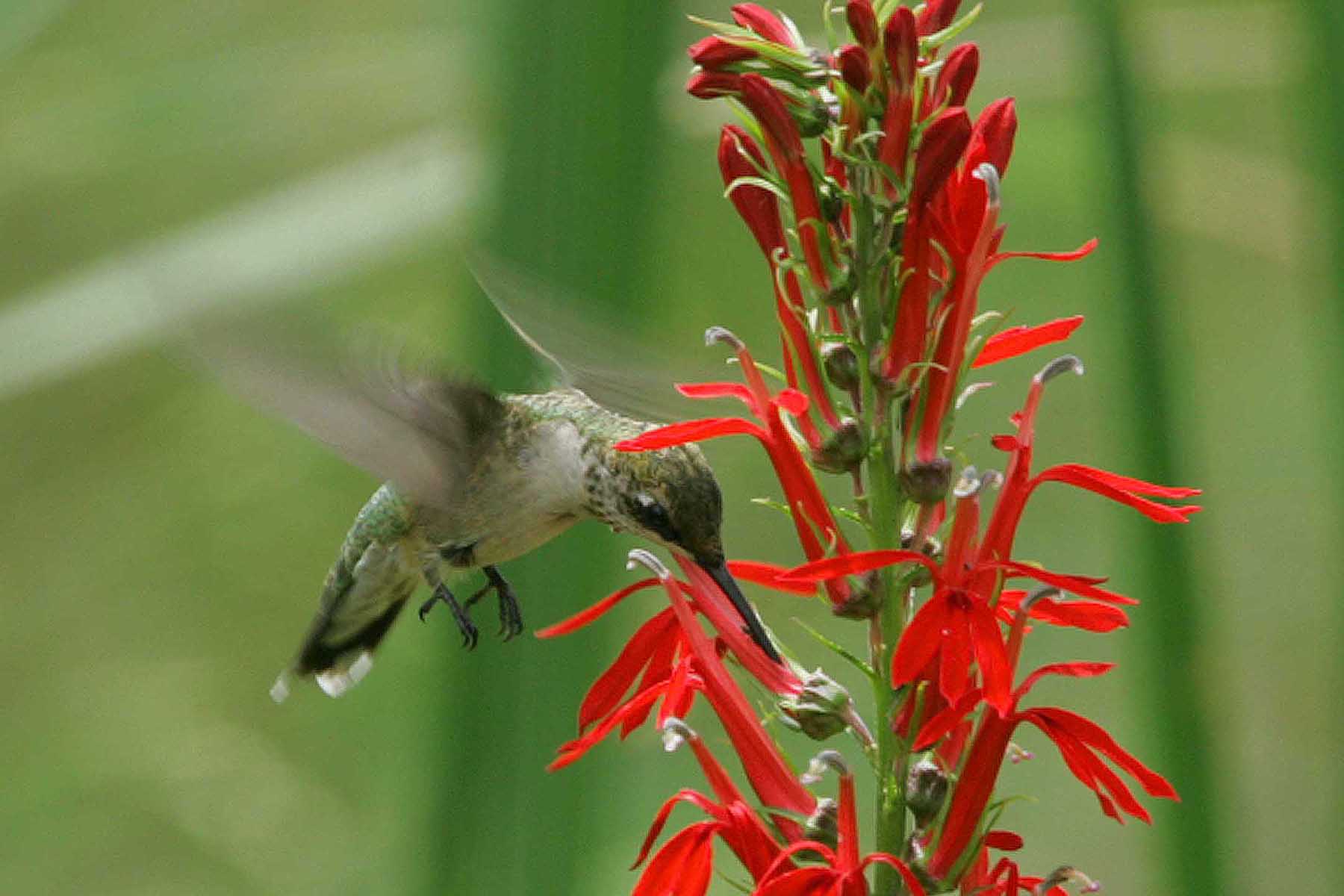
Sixteen nectar-rich, hummingbird-tested plants, organized by bloom time and hardiness zone so your garden feeds these tiny birds from the first spring arrivals through the last fall migration.
The short version
The most reliable plants for hummingbirds are red and orange tubular flowers rich in nectar: cardinal flower, bee balm, trumpet honeysuckle, salvia, penstemon, and coral bells lead the pack. Native species generally hold far more nectar than hybrids and petunias, so build the backbone of your garden around plants indigenous to your region. The real secret is succession, not any single plant. Stagger early, mid, and late bloomers so something is always in flower from the moment hummingbirds arrive in spring until they leave in fall. And skip the pesticides entirely. Hummingbirds eat small insects and spiders for protein, so a chemical-free, insect-friendly garden feeds them as much as the flowers do.
What actually pulls hummingbirds into a garden
A hummingbird burns through fuel at a rate that would terrify any other animal. To keep that tiny engine running, it visits between one and two thousand flowers a day and eats roughly every ten to fifteen minutes during daylight. Nectar makes up about ninety percent of its diet, and the bird is essentially shopping every waking minute. When you understand that economy of constant hunger, planting for hummingbirds stops being a matter of one showy plant and becomes a matter of designing a reliable, season-long buffet.
Three traits make a flower worth a hummingbird's attention. The first is shape. Hummingbirds are built for tubular blooms, the kind shaped like a narrow champagne flute, because their long bills and even longer tongues reach nectar that bees and butterflies cannot. The second is nectar volume. A flower can look perfect and still disappoint if it holds little nectar, which is exactly why many fancy bedding hybrids underperform. The third is color. Red and orange grab a hummingbird's eye first because those birds see red vividly and most insects do not, so a scarlet bloom advertises a meal that has not already been drained by competitors.
Color, though, is more of a billboard than a requirement. Hummingbirds will happily work pink, purple, blue, and even pale yellow flowers once they have learned a patch is productive. The red-first rule simply describes what catches their attention from a distance. Plant a strong scarlet anchor to flag your garden as a feeding station, then surround it with whatever nectar-rich colors you love, and the birds will learn the whole patch within a few visits.
Native plants deserve the center of any serious hummingbird garden. Indigenous species like trumpet honeysuckle, bee balm, and cardinal flower coevolved with North American hummingbirds and generally produce far more nectar than exotic hybrids bred mainly for flower size or unusual color. Research on pollinator gardens consistently finds native plants several times more attractive to pollinators than ornamental non-natives. Use natives as your foundation, then let a few well-behaved exotics extend the bloom season at the edges.
The last piece is the one most beginners miss. Insects are not the enemy of a hummingbird garden, they are part of the menu. Adult hummingbirds eat small spiders, gnats, aphids, and other arthropods for the protein that nectar cannot supply, and nestlings are fed almost entirely on insects. A garden doused in pesticide starves the birds of that protein and can poison them directly through contaminated nectar. The most hummingbird-friendly thing you can do, after planting the right flowers, is to put the sprayer away for good.
How we chose
How we chose these sixteen, and how to plant them
Every plant on this list earns its spot on three counts. It produces genuinely high nectar volume in a form hummingbirds can reach, it is widely available at independent nurseries and reputable mail-order growers across a broad swath of hardiness zones, and it has a documented track record of drawing hummingbirds rather than just a reputation borrowed from a seed packet. Where a plant only shines in one region, we say so plainly instead of pretending it works everywhere.
We organized the picks around bloom season because that is the single most useful way to think about a hummingbird garden. A yard full of June bloomers leaves the birds hungry in April and again in September, precisely the migration windows when fuel matters most. The sixteen below span early spring through hard frost so you can assemble a sequence rather than a single peak. Aim to have at least two or three different species in flower at any given week from your last spring frost to your first fall one.
Read your zone before you buy
USDA hardiness zones tell you the average coldest winter temperature a perennial must survive, and they are the difference between a plant that returns for a decade and one that dies its first January. The zones below are the published cold-hardiness ranges for each species. If you garden at the cold edge of a plant's range, site it in a sheltered spot and mulch the crown heavily after the ground freezes. If you garden warmer than its range, treat it as a fast annual or grow it in a pot you can overwinter indoors.
Bloom window
Plants to lean on
Why it matters
Early spring
Coral honeysuckle, columbine, Virginia bluebells
Feeds the first scouts that arrive before most flowers open
Sun and soil come next. The large majority of strong nectar plants want full sun, meaning six or more hours of direct light, and most prefer soil that drains freely rather than staying soggy. Cardinal flower is the famous exception, craving consistently moist ground and tolerating part shade, which makes it the right plant for that low, damp corner where everything else sulks. Match the plant to the spot rather than fighting your conditions, and you will spend far less time nursing struggling roots.
1. Cardinal flower (Lobelia cardinalis)
If you plant one thing for hummingbirds, make it cardinal flower. Its spikes of intense scarlet, perfectly tube-shaped blooms are practically designed for a hummingbird's bill, and they open in mid to late summer right when nesting demand peaks. Unusually for a top nectar plant, it craves moisture and tolerates part shade, thriving in the wet, low spots where other flowers fail. Hardy in roughly USDA zones 3 to 9, it grows two to four feet tall. Keep the soil consistently damp, never let it dry out in summer, and let a few flowers set seed since the plant is short-lived and reseeds to keep itself going.
2. Scarlet bee balm (Monarda didyma)
Bee balm throws up shaggy crowns of red, pink, or lavender tubular florets through summer and reads to a hummingbird as a loaded feeding station. The native scarlet species draws the most birds, and cultivars like Jacob Cline offer larger blooms plus strong mildew resistance, the plant's main weakness. Hardy in zones 3 to 9 and growing two to four feet, it spreads by runners, so give it room or divide it every few years. Plant in full sun to part shade in rich, evenly moist soil, thin the stems for airflow, and you will have both hummingbirds and bumblebees working it all season.
3. Trumpet honeysuckle (Lonicera sempervirens)
This well-behaved native vine is one of the earliest and most important hummingbird plants, opening clusters of coral-red trumpets in spring just as migrants arrive, then reblooming on and off into fall. Unlike the invasive Japanese honeysuckle, it stays mannerly and is evergreen in mild climates. Hardy across zones 4 to 9, it climbs eight to fifteen feet on a trellis, fence, or arbor in full sun to part shade. It is forgiving of average soil once established, and a light shearing after the first flush of bloom encourages a fresh round of flowers.
4. Salvia (Salvia species)
No genus pulls more weight in a hummingbird garden than salvia. Tender scarlet sage (Salvia splendens) and pineapple sage bloom nonstop in red until frost, while hardy perennials like Salvia greggii and autumn sage return for years in zones 6 to 9. The tubular flowers come in red, coral, hot pink, and deep blue, all of them nectar-rich and built for hummingbird bills. Most salvias demand full sun and sharp drainage and shrug off heat and drought once established. Shear the perennial types midseason to keep them blooming, and let some flower into fall for migrants.
Building it into a garden that feeds them all season
Once you have chosen plants from each bloom window, the work shifts from selection to arrangement. Think in drifts rather than dots. A cluster of three to five cardinal flowers reads as a beacon from the air, while a lone plant is easy to overlook. Place your tallest performers, trumpet vine and bee balm among them, toward the back or along a fence where they have room to spread, and tuck shorter coral bells and columbine toward the front edge where you and the birds can both enjoy them up close.
Layer the heights deliberately so the garden offers feeding stations at every level. Hummingbirds will work a six-foot trumpet vine and a ten-inch coral bells in the same visit, and a planting that stacks tall, medium, and low blooms simply holds more meals per square foot. Leave a few open sightlines and a bare twig or thin branch somewhere nearby, because hummingbirds perch constantly between feeding bouts to digest and to guard their territory.
Water is the quiet other half of the equation. Hummingbirds rarely use a deep birdbath, but they love to fly through a fine mist or bathe on broad wet leaves. A simple mister attached to a hose, or a shallow dripper over a flat stone, will pull birds in to bathe and often convince a passing scout to stick around. Position it near your densest flower block so a bird that comes to drink discovers the buffet next door.
Resist the urge to tidy too aggressively. The aphids on your milkweed and the tiny spiders strung between stems are protein the birds need, and a garden run without pesticides will hum with the small insects that feed nestlings. If pests genuinely get out of hand, blast them off with a hose or pick them by hand rather than reaching for a spray. Even products labeled organic can harm a bird with a metabolism this fast.
Finally, give the garden a season to prove itself before you judge it. Hummingbirds learn a landscape over time, returning to productive spots year after year, sometimes the very same individuals on migration. The patch that draws one curious scout in its first July can become a regular stop for a dozen birds two summers later. Plant the relay, hold off the sprayer, keep something blooming, and the birds will write the rest of the story themselves.
Frequently asked questions
What plants attract hummingbirds the most?
Red and orange tubular natives are the strongest draws: cardinal flower, scarlet bee balm, trumpet honeysuckle, and red salvia are about as close to a guarantee as gardening offers. They combine the tube shape hummingbird bills are built for with high nectar volume that hybrids and bedding plants rarely match. Build your garden's backbone from those four and add regional natives like penstemon or agastache to round out the bloom season.
Do hummingbirds like petunias?
Plant most perennials in spring or early fall so roots establish before summer heat or winter cold. Set them at the same depth they grew in the pot, water deeply at planting, and keep the soil evenly moist for the first three to four weeks while roots reach out. Skip high-nitrogen fertilizer, which pushes leafy growth at the expense of the blooms you actually want. A light topdressing of compost in spring is plenty for almost everything here.
A hummingbird garden is not one perfect plant. It is a relay where something is always in bloom.
5. Penstemon (Penstemon species)
Penstemons, also called beardtongues, carry spires of tubular flowers packed with nectar, and dozens of species are native across the West from desert flats to mountain meadows. Firecracker penstemon (Penstemon eatonii) and pineleaf penstemon are standout reds for dry gardens. Hardiness varies by species but many cover zones 3 to 8, and most stand one to three feet tall. The key to success is drainage: penstemons rot in wet winter soil, so plant them in gritty, lean ground in full sun and resist the urge to pamper or overwater them.
6. Coral bells (Heuchera species)
Gardeners grow coral bells for their colorful foliage, but hummingbirds come for the airy wands of tiny tubular bells that rise above the leaves in late spring and early summer. Native coralbells (Heuchera sanguinea) carry the reddest, most nectar-rich flowers, so choose those over foliage-only hybrids if birds are your aim. Hardy in zones 4 to 9 and forming neat ten-to-eighteen-inch mounds, they tolerate part shade and make an excellent front-of-border or container plant. Give them rich, well-drained soil and divide every few years to keep the crowns from heaving out of the ground.
7. Wild columbine (Aquilegia canadensis)
Eastern wild columbine is an early-spring lifeline, its nodding red-and-yellow spurred flowers opening when little else is available and hummingbirds are hungry from migration. The long spurs hold nectar deep, an arrangement that practically locks out short-tongued insects and reserves the reward for hummingbirds. Hardy in zones 3 to 8, it grows one to three feet and happily naturalizes in part shade and woodland edges. It is short-lived but self-sows freely, so let a few seed heads ripen and scatter, and you will have a self-renewing colony within a couple of seasons.
8. Agastache (Agastache species)
Hummingbird mint, as agastache is aptly nicknamed, sends up long spikes of tubular flowers in orange, coral, pink, and purple that hummingbirds work tirelessly from midsummer through fall. Western hyssops in particular bloom late, making them a crucial fuel source for the southbound migration. Most are hardy in zones 5 to 9, stand two to four feet, and carry aromatic foliage that deer and rabbits avoid. They are tough, drought-tolerant plants for full sun and lean, well-drained soil, but like penstemon they resent wet winter feet, so do not plant them in heavy clay.
9. Trumpet vine (Campsis radicans)
Few plants draw hummingbirds as dramatically as trumpet vine, whose big orange-red trumpets are a midsummer feast. The catch is vigor: this native is muscular and aggressive, climbing thirty feet and suckering enthusiastically, so it belongs only on a sturdy structure with room to roam, never against a house foundation. Hardy in zones 4 to 9, it wants full sun and is wholly unfussy about soil. Plant it where you can prune it hard every year to control its spread, and consider the better-behaved cultivar Madame Galen if you want the flowers with less of the thuggery.
10. Red hot poker (Kniphofia species)
The torch-like spikes of red hot poker, glowing red, orange, and yellow, are packed with tubular florets that hummingbirds mob through summer. The bold vertical shape doubles as a striking architectural accent in the border. Hardy in roughly zones 5 to 9 and reaching two to four feet in bloom, kniphofia demands full sun and excellent drainage, especially in winter, when soggy crowns rot. Plant it on a slope or in a raised bed if your soil holds water, cut spent spikes to encourage rebloom, and leave the evergreen foliage in place over winter to protect the crown.
11. Cape fuchsia (Phygelius species)
Cape fuchsia dangles loose panicles of slender tubular flowers in coral, red, and soft yellow from early summer until frost, a long season that keeps hummingbirds returning. This South African native behaves like a soft-wooded shrub, hardy in zones 7 to 10 and grown as an annual or container plant in colder regions. It reaches three to five feet and prefers full sun to light shade with steady moisture. Deadhead spent flower stems to keep the show going, and in cold-edge gardens cut it back hard in spring after winter dieback to spur fresh growth.
12. Scarlet runner bean (Phaseolus coccineus)
For an edible plant that feeds you and the birds, scarlet runner bean is hard to beat. This fast-climbing annual covers a trellis in weeks and produces a long succession of vivid red, sweetly tubular flowers that hummingbirds adore, followed by edible pods and beans. Grown as an annual everywhere, it wants full sun, average soil, and something tall to climb, easily reaching eight to twelve feet in a single season. Sow seeds directly after the last frost, keep the roots watered, and pick the pods young to keep the vine flowering longer.
13. Cigar plant (Cuphea ignea)
Cigar plant earns its name from slim tubular flowers tipped in orange-red and black that look like tiny lit cigars, and hummingbirds work them relentlessly from summer until frost. It blooms without pause and never needs deadheading, making it one of the lowest-maintenance nectar plants you can grow. Hardy only in zones 9 to 11, it is grown as an annual or container plant nearly everywhere else, forming neat one-to-two-foot mounds. Give it full sun and average, well-drained soil, water during dry spells, and it will flower nonstop with essentially zero fuss.
14. Zinnia (Zinnia elegans)
Zinnias are not tubular, but their broad, nectar-rich landing-pad blooms draw hummingbirds anyway, especially the red and orange single-flowered types that keep their nectar accessible. As fast, cheerful annuals they fill the late-summer gap brilliantly and double as a magnet for butterflies. Grown as annuals in every zone, they want full sun and reach one to four feet depending on variety. Sow seed directly after frost, pinch young plants to branch them, and deadhead often, since cutting blooms for the vase only makes them flower more enthusiastically.
15. Weigela (Weigela florida)
This old-fashioned deciduous shrub smothers itself in trumpet-shaped pink to red flowers in late spring, filling the awkward gap between early vines and high-summer perennials. Hummingbirds work the blooms heavily during that window, and reblooming cultivars like Sonic Bloom extend the show into summer. Hardy in zones 4 to 8 and growing three to six feet, weigela is undemanding in full sun to part shade and average soil. Prune right after the spring bloom finishes, since it flowers on old wood, and choose a compact cultivar if border space is tight.
16. Crocosmia (Crocosmia species)
Crocosmia sends up arching sprays of fiery red and orange tubular flowers in mid to late summer, held on wiry stems above sword-shaped leaves that bring a tropical look to the border. The cultivar Lucifer is the classic, a tall, vivid scarlet that hummingbirds find irresistible. Grown from corms and hardy in zones 5 to 9, it reaches two to four feet and naturalizes into generous clumps over time. Plant the corms in spring in full sun and well-drained soil, water through summer growth, and divide congested clumps every few years to keep the bloom heavy.
Yes, hummingbirds will visit petunias, which are brightly colored and loosely tubular. But cultivated petunias hold much less nectar than native nectar plants, so a garden built only on petunias tends to lose its birds to a neighbor's richer flowers. Treat petunias as a colorful supplement in pots and beds, not as the centerpiece of a serious hummingbird planting.
What color flowers do hummingbirds prefer?
Hummingbirds notice red and orange first because they see those colors vividly while most competing insects do not, so a scarlet bloom signals nectar that probably has not been drained. That said, they readily feed on pink, purple, blue, and yellow flowers once they have learned a patch is productive. Plant a red anchor to advertise the garden, then use any nectar-rich color you like alongside it.
When should I plant for hummingbirds, and when do they arrive?
Plant perennials in spring or early fall so roots establish in mild weather. Hummingbirds migrate north starting in early spring and often arrive before gardens are in full bloom, so include early bloomers like coral honeysuckle and columbine, and consider hanging a feeder a week or two ahead of your expected first arrival to catch the scouts.
Why should I avoid pesticides in a hummingbird garden?
Hummingbirds eat small insects and spiders for the protein nectar cannot provide, and nestlings are fed almost entirely on arthropods. Pesticides wipe out that food supply and can poison birds directly through contaminated nectar and prey. Because hummingbirds have such fast metabolisms, even small chemical exposures matter, so manage pests with water sprays, hand-picking, and tolerance rather than sprays, including most organic ones.
Do I still need a feeder if I plant the right flowers?
A well-planted garden can feed hummingbirds without a feeder, but a clean feeder filled with a simple one-part-sugar-to-four-parts-water solution bridges gaps between bloom windows and helps during early spring and late fall migration. If you use one, skip the red dye and the honey, and change the solution every two to three days in hot weather to prevent mold and fermentation.