
December Birth Flower: Narcissus and Holly
December claims two birth flowers: the paperwhite narcissus, which blooms indoors without any cold treatment, and holly, the prickly evergreen whose red berries have decorated midwinter celebrations for two thousand years.
December has two birth flowers: narcissus, specifically the paperwhite (Narcissus papyraceus), and holly (Ilex aquifolium and its American cousin Ilex opaca). Paperwhites are the only narcissus that need no cold period before they bloom, which makes them uniquely suited to forcing indoors in December. Holly is a dioecious evergreen shrub or small tree, and only the female plants produce the glossy red berries we associate with the season. Both plants carry centuries of symbolism around protection, renewal, and the return of light at the year's darkest point.
Paperwhites are reliably perennial in USDA Zones 8 through 11. Gardeners in Zones 6 and 7 can overwinter bulbs with heavy mulch, but north of that you treat them as annual indoor bulbs, forcing them in pebbles and water. Holly species span a wider range: American holly is hardy from Zone 5 to 9, while English holly prefers Zones 6 to 9. Both are toxic to pets and humans if ingested.
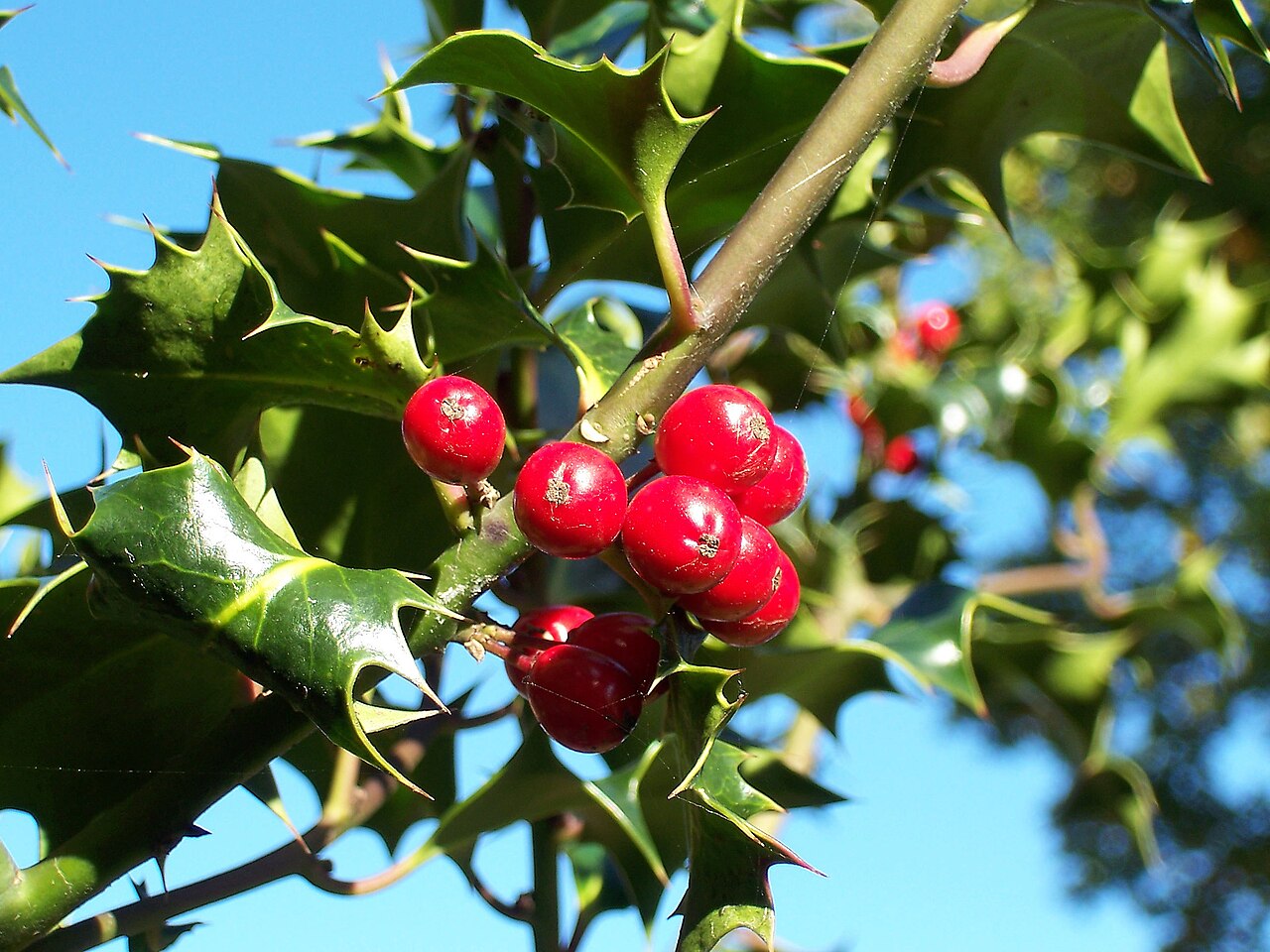
The December Birth Flowers
December sits at the edge of the year with two very different plants as its official birth flowers. Paperwhite narcissus (Narcissus papyraceus) is a Mediterranean bulb with intensely fragrant white blooms that appear in the dead of winter without any cold conditioning. Holly (Ilex aquifolium, Ilex opaca) is the prickly, berry-laden evergreen that has decorated midwinter gatherings from Roman Saturnalia straight through to modern Christmas. One is delicate and fleeting; the other is a 50-foot tree that outlives everyone who plants it. Together they map the full emotional range of the month.
The pairing makes botanical sense. Paperwhites bloom at the season when almost nothing else does, offering that particular kind of hope that only exists when it is improbable. Holly holds steady, green and glossy and defiant, when the rest of the garden has gone gray. Both plants have been in continuous cultivation for more than a thousand years, which tells you something about the human need for beauty in December, regardless of hemisphere or tradition.
Paperwhite Narcissus: Meaning, Symbolism, and What It Asks of You
The symbolism of narcissus is layered in ways most gift-card copy glosses over. Victorian floriography read a single stem as unrequited love, but a bouquet meant devotion, good wishes, and respect. Chinese cultivators called it shuixian, meaning water immortal, and forced the bulbs in pebbles and water to bloom precisely at Lunar New Year, linking the flower to prosperity and a clean start. The Greek myth is darker: Narcissus the youth, so transfixed by his own reflection that he couldn't stop staring, wasted away and became the drooping flower that bears his name. December babies get both readings, the beautiful and the cautionary.
For growing purposes, the cultivar matters. 'Ziva' is the standard commercial variety and the one most likely to show up in garden-center bags, reliably fragrant and fast to bloom. 'Inbal' has shorter, sturdier stems that don't flop as badly in a warm room. 'Ice Follies' blooms later and carries a milder scent, which suits people who find the classic paperwhite fragrance overwhelming (the compound profile includes indole, which is the same chemical that gives jasmine and certain cheeses their edge, and not everyone loves it). If you're forcing indoors, pack the bulbs shoulder-to-shoulder, pointed-end up, in at least two to three inches of gravel, with water just grazing the bulb base.
One trick I wish more people knew about: once the shoots hit one to two inches, replace your water with a five-percent alcohol solution. That is roughly one part 80-proof vodka to seven parts water. Cornell University research showed this reduces final stem height by 30 to 50 percent without affecting flower size, color, or fragrance. Shorter stems mean fewer flops, fewer staking emergencies, fewer vases tipping over on the mantle. Keep the pot in a cool room (55 to 60 degrees Fahrenheit) for the first week, then move it into warmth and bright indirect light. Roots appear within 7 to 10 days and the flowers follow in four to six weeks.
One warning I take seriously: narcissus sap causes skin irritation in sensitive people, a condition florists call daffodil itch. Always condition cut paperwhites in their own water for several hours before mixing them with roses or other flowers. The stem sap contains alkaloids that block water uptake in neighboring stems, and you will lose the roses before you figure out why. Indoors, zone-wise, paperwhites are a gift to everyone in Zones 3 through 7 who can't grow them in the ground. In Zones 8 through 11 they naturalize in the soil with no intervention. In my zone-7b garden, I've overwintered bulbs under six inches of straw with moderate success, but I wouldn't bet the whole planting on it.
Holly: What the Berries Actually Require
Holly's symbolism runs older and stranger than most people realize. The Druids brought holly indoors at winter solstice to shelter forest spirits and preserve the sun's power through the longest nights. Romans draped it on doorways during Saturnalia in late December, a festival of gift-giving and feasting that flowed directly into Christian Christmas traditions. Early church writers mapped the plant onto the Passion, reading the sharp leaves as the crown of thorns, the red berries as blood, the white spring flowers as purity, and the bitter bark as the gall offered at the cross. Medieval carol-writers did the same in The Holly and the Ivy. In neopagan tradition, the Holly King rules the darkening half of the year, from midsummer to winter solstice, and is ritually defeated by the Oak King at the solstice when the days begin to lengthen again. Every culture that passed through northern Europe's December seems to have found holly useful.
The practical reality of growing holly for berries is something most gardening articles underplay. Holly is dioecious: male and female flowers grow on separate plants, and only females produce berries. You need at least one male within roughly 50 feet to pollinate a female. Named male pollinators include 'Blue Prince' and 'Blue Stallion'. Reliable berry-producing females include 'Blue Princess', 'Nellie R. Stevens' (partially self-fertile in warmer zones), 'Burford', and the English holly cultivar 'J.C. van Tol', which is also partially self-fertile. If your holly never berries, the first question is whether it is female and the second is whether a male is close enough.
Ilex opaca, the American holly, is harder than its English cousin, reliably hardy from Zone 5 through 9. Ilex aquifolium (English holly) prefers Zones 6 through 9 and struggles with severe cold and strong drying winds. Both want slightly acidic soil (pH 5.0 to 6.5), full sun for best berry set, and good drainage. Holly tolerates clay better than most ornamentals but will not sit in standing water. Growth is slow, running roughly 8 to 15 feet over 20 years under typical garden conditions, though a well-sited American holly can eventually reach 50 feet.
Growing and Gifting December's Flowers: Zone-by-Zone Reality
For paperwhites, the gifting question and the growing question are nearly the same because the indoor-forcing method is the best gift you can give a December birthday. Buy a bag of 'Ziva' or 'Inbal' bulbs, a low ceramic bowl, and a bag of river pebbles. Pack the bulbs tight, water to the base, tuck a card inside, and hand over the whole kit. The recipient gets to watch roots appear in a week and flowers in a month. If you're sending to someone in Zones 8 through 11, you can gift outdoor bulbs instead with a note to plant them four to six inches deep in a sunny well-drained spot in October or November. They'll come back every year and multiply freely.
For holly, the pruning calendar matters enormously and most people cut at the wrong time. Do not prune holly in autumn if you want Christmas berries. The berries form on the previous season's wood, so autumn pruning removes exactly the stems that would have given you the show. Prune in late winter or very early spring before new growth begins. Holly is extraordinarily tolerant of hard cutting, so don't be timid, but time it right. For hedging, an annual light trim after the berries have dropped is sufficient. For a specimen tree, leave it alone and let it build its natural pyramidal form.
Toxicity is real for both plants. All parts of the narcissus contain lycorine and other alkaloids that are toxic if ingested by humans, dogs, or cats. The bulb carries the highest concentration. Holly berries are toxic to humans, dogs, and cats, and the glossy red color is genuinely attractive to small children. Neither plant belongs in a home with toddlers who put things in their mouths, and both should stay off the ground around dogs who graze. The birds, however, are fine with holly berries and will thank you for them. Thrushes and robins use holly as a winter larder when other food sources run short.
Two Thousand Years of December Flowers
Paperwhite narcissus traveled from the Mediterranean along trade routes to China over a thousand years ago. Chinese gardeners developed the shuixian forcing tradition, growing the bulbs in shallow dishes of water and pebbles to bloom at Lunar New Year, a practice so precisely parallel to the Western paperwhite-in-a-vase method that it's almost startling. Same bulb, same technique, different hemisphere, different new year, same meaning: brightness and good fortune arriving at the bleakest time. The paperwhite didn't need to be adapted for this use; it arrived ready-made for it.
Holly's pre-Christian career is equally long. Roman soldiers sent holly sprigs to friends during Saturnalia in mid-December, a custom that passed into Christmas cards with remarkable directness. An 1800s Scottish duke reportedly rerouted an entire road rather than cut down a holly tree on the planned path, which is the kind of story that tells you about the weight a plant can carry in a culture. Delaware named the American holly its state tree in 1939. The Yaupon holly, Ilex vomitoria, is the only North American plant known to contain caffeine, and indigenous peoples brewed it into a ceremonial drink well before European contact.
What I notice, growing both in a zone-7b garden, is that they serve opposite functions. Paperwhites are the thing you bring indoors to prove that growth is still possible in December. They bloom because you forced them, and the effort is visible and satisfying. Holly just stays. It was green last January, it is green this January, it will be green after I'm gone. One plant is about hope as an act of will; the other is about persistence as a fact of nature. December people seem to need both readings, and two birth flowers is, perhaps, exactly the right number for the last month of the year.