
Coneflowers
A tough native prairie perennial that blooms for months, feeds pollinators all summer and finches all winter, and asks almost nothing of you in return.
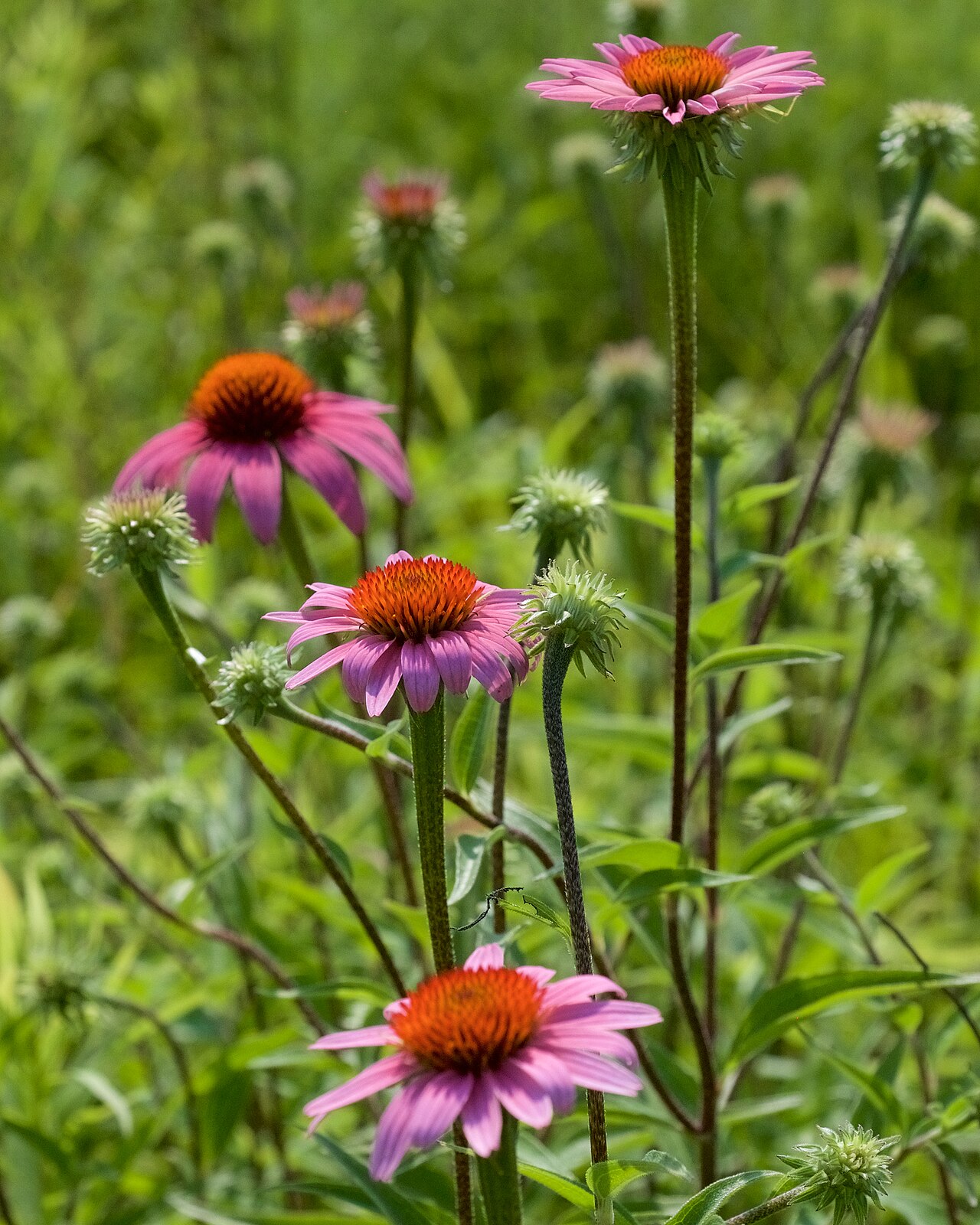
Coneflowers are the plant I recommend more than any other for a new pollinator border — native, drought-tough, long-blooming, and nearly impossible to kill.
Echinacea purpurea is a clumping perennial in the daisy family, native to central and eastern North America and hardy across USDA zones 3–9. It blooms from early summer into fall — roughly June to October — in daisy-form flowers with a stiff, spiny central cone.
Why grow coneflowers
In my zone 7b clay they're a backbone plant: once established they shrug off drought, the bees and butterflies work them all summer, and if I leave the seedheads standing the goldfinches strip them through winter. They earn their space three seasons over.
'Magnus' — the standard purple, with large flowers held nearly flat (rather than drooping) on deep-orange cones. Drought-tolerant and a 1998 Perennial Plant of the Year. My default coneflower.
'PowWow Wild Berry' / 'PowWow White' — shorter (18–24 in), free-flowering selections that bloom fast from seed and stay tidy in the front of a border.
Species Echinacea purpurea — straight species seed, the best choice if you want the strongest pollinator value and self-sowing colonies.
A word on the rainbow of new echinacea. Breeders have flooded the market with oranges, reds, doubles, and pom-pom forms — 'Cheyenne Spirit', the 'Sombrero' series, the doubled 'Cone-fections'. They're striking, and I grow a few. But be honest with yourself about two things: the fancy doubles offer pollinators far less than the open single species (a bee can't work a pom-pom), and many of the wild colors are shorter-lived and less winter-tough than plain Echinacea purpurea. For a low-input, long-lived, genuinely useful planting, the straight species or a proven selection like 'Magnus' still wins.
Beyond the garden, coneflower is the echinacea of herbal-remedy fame — the roots and tops of Echinacea purpurea and E. angustifolia are the source of the immune-support tinctures on pharmacy shelves. You don't need to do anything with that to enjoy the plant; it's just a reminder that this is a working prairie native with a long human history, not a fussy ornamental.
Care guide
Caring for coneflowers
Light. Full sun. They'll take a little afternoon shade but flop and bloom less for it. Sun keeps the stems stiff and self-supporting.
Water & soil. This is the easy part — coneflowers are genuinely drought-tolerant once established and they want lean, well-drained soil. They handle my clay fine; what they won't tolerate is wet feet in winter, which rots the crown. Don't pamper them. Rich, soggy, over-watered ground is the fastest way to lose one.
Feeding. Almost none. A native prairie plant wants lean soil; overfeeding gives you tall floppy growth and fewer flowers. A thin spring compost mulch is the most I do.
Deadheading & winter. Deadhead through summer for more bloom — but in fall I deliberately stop and leave the cones standing. They're winter food for finches and they look architectural under frost. Cut back in early spring before new growth.
Longevity. Divide every three or four years to keep clumps vigorous, and let a few seedheads ripen if you want self-sown replacements coming along.
Spacing & first year. Set plants 18–24 inches apart — close enough to read as a drift, far enough for the airflow that keeps mildew off. The first season is the only one that asks much of you: water a new coneflower through its establishing summer, then let it fend for itself. After year one, supplemental water is the exception, not the rule.
Propagation
Propagating coneflowers
The straight species is one of the most rewarding perennials to grow from seed, and division refreshes named clumps.
Seed (species) needs cold to germinate well: sow outdoors in fall, or cold-stratify in the fridge for four to six weeks, then sow. They often bloom in their second year.
Self-sowing happens freely if you leave seedheads — I move volunteer seedlings each spring to where I want them.
Division in early spring or fall: lift the clump and split it into vigorous pieces with roots and buds. This is the way to multiply named cultivars, which don't come true from seed.
Troubleshooting
Common coneflower problems
Coneflowers are about as trouble-free as a perennial gets, and most failures come from kindness — too much water, too much food, too rich a soil.
Crown and root rot — the real killer. It's almost always wet winter soil. Plant in well-drained ground, never let them sit soggy, and resist over-watering established plants.
Aster yellows — a phytoplasma that produces distorted, greenish, deformed flowers. There's no cure; pull and bin affected plants (don't compost) and control the leafhoppers that spread it.
Powdery mildew — minor; improve airflow and water at the base. Rarely serious on coneflowers.
Japanese beetles — they'll chew petals. Hand-pick into soapy water in the morning.
The fastest way to kill a coneflower is to treat it well — lean soil, full sun, and benign neglect are exactly what it wants.