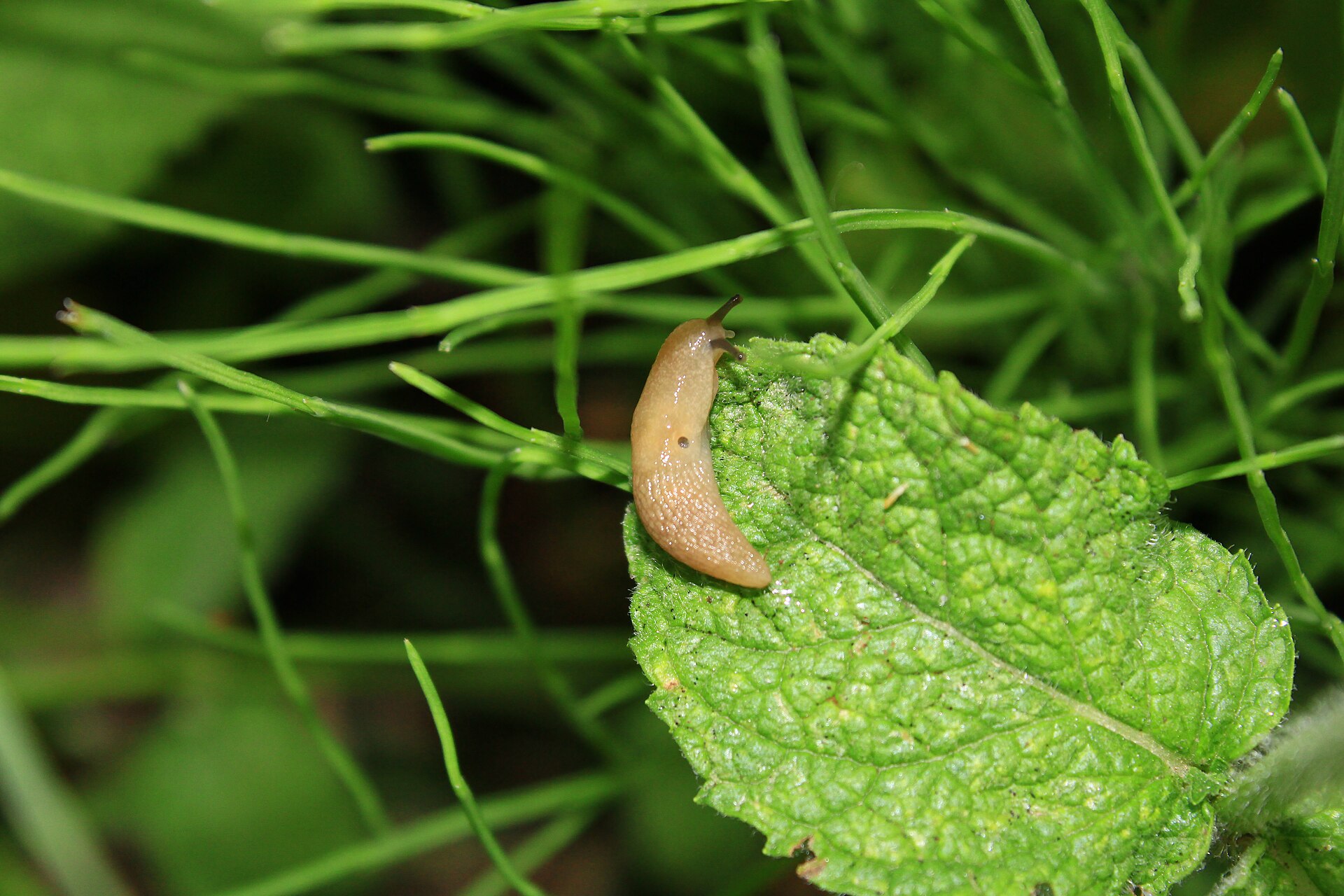
A tested, organic-first plan for the slugs and snails shredding your garden, from nightly handpicking to iron phosphate bait, with honest notes on what actually works and what is folklore.
Know your enemy: slugs, snails, and why they own the night
Slugs and snails are not insects. They are gastropod molluscs, soft-bodied relatives of clams and mussels that glide on a muscular foot lubricated by mucus. A snail carries a coiled external shell it can retreat into; a slug has either a tiny internal remnant of a shell or none at all, which is why slugs squeeze into soil cracks and under boards that a shelled snail cannot reach. In a garden bed they cause the same kind of damage and respond to the same controls, so it is fair to treat them as one problem with two faces.
The species you meet depends on where you garden. Across much of North America and Europe the brown garden snail, Cornu aspersum, is the headline pest, a stout, mottled snail introduced from the Mediterranean and now thoroughly at home in vegetable plots and citrus. Alongside it work an assortment of slugs, from the small gray field slug that swarms seedlings to the large leopard and Spanish slugs that can stretch several inches. You do not need to key them out to Latin precision. You need to recognize the trail, the holes, and the conditions that bring them out.
What unites all of them is water. Gastropods breathe partly through their skin and dry out fast, so they are creatures of damp and dark. They feed at night and on overcast, drizzly days, then spend daylight hours tucked under mulch, pots, boards, low foliage, and the lip of raised beds where the soil stays cool and moist. This single fact is the hinge of organic control: if you understand that slugs are managing their own dehydration, every successful tactic suddenly makes sense, from morning watering to copper bands to the humble upturned board.
They are also remarkably mobile for their size. A slug will travel many yards in a night to reach a favored plant and follow its own slime trail back to a daytime hideout, which is why a bed can look untouched at noon and ravaged by morning. Cool, moist spring and fall weather is prime feeding season, and a mild, wet climate, the kind that defines the Pacific Northwest, the British Isles, and the maritime Northeast, gives them a year-round advantage that a hot, dry summer garden in Arizona never has to face.
Before you spend a dollar on bait, learn to read the garden. The rest of this plan assumes you can tell slug damage from cutworm, earwig, or rabbit damage, and that you can find where they sleep. Get those two skills and you are most of the way to controlling them without reaching for anything toxic.
Symptoms & ID
Reading the damage: silvery trails, ragged holes, and lookalikes
The signature of a slug or snail is the slime trail. As they move they secrete mucus that dries to a silvery, slightly iridescent ribbon, easiest to spot in early morning raking light across leaves, stems, pots, and pavers. If you can find that glistening trail near chewed foliage, you have your culprit. No other common garden pest leaves it, so the trail is the single most reliable piece of evidence you have.
The feeding damage itself is distinctive once you know it. Slugs and snails rasp tissue away with a tongue-like radula covered in tiny teeth, leaving irregular holes with smooth, clean edges in the middle of leaves, and ragged notches along the margins. The holes are not skeletonized like beetle damage and not sharply geometric. On tender seedlings the damage is brutal and fast: whole cotyledons and stems can vanish overnight, and a flat of lettuce or a row of bean seedlings can be cut to stubs before it ever establishes.
They show clear favorites. Soft, low foliage and ripening fruit take the worst hits, so look first at lettuce, hostas, basil, marigolds, delphiniums, strawberries, and the lower leaves and fruit of tomatoes. Citrus, leafy greens, and seedlings of almost anything are high-risk. Tough, hairy, aromatic, or silver-leaved plants, like rosemary, lavender, sage, ferns, euphorbia, and most ornamental grasses, are usually left alone, which is a useful planting clue when you are trying to lower a bed's overall vulnerability.
Timing of discovery is itself a diagnosis. If a plant looks fine at midday but is freshly chewed by morning, suspect molluscs over daytime feeders. To confirm, go out after dark with a flashlight, because that is when slugs and snails are actually on the plants. Seeing them in the act removes all doubt and, conveniently, is also step one of treatment.
Silvery slime trails; active at night and on damp days
Cutworms
Seedlings cut clean off at the soil line overnight
Fat gray caterpillars curled just under the surface by day
Earwigs
Many small ragged holes in leaves and petals
No slime trail; earwigs sheltering in tight crevices
Caterpillars and beetles
Life cycle
The life cycle that decides your timing
You cannot out-handpick a breeding population you do not understand, so it is worth knowing how these animals reproduce. Most garden slugs and snails are hermaphrodites: each individual carries both male and female organs, and after mating, both partners can go on to lay eggs. A few species can even self-fertilize. The practical takeaway is uncomfortable but important. Every adult you fail to remove is a potential egg-layer, so control is a numbers game won by reducing the breeding adults, not just the ones currently chewing.
The egg stage is where the next outbreak hides. Slugs lay clusters of translucent, gel-like eggs, often in batches of a few dozen, tucked an inch or so under loose soil, beneath boards, in compost, and inside the moist crevices of raised beds. Snails lay larger clutches; the brown garden snail averages around 80 spherical, pearly-white eggs at a time and can do so several times a year. Those pale, BB-sized clusters in your soil and compost are not fertilizer pellets or fungus. They are the next generation, and crushing a clutch you find while weeding removes dozens of future feeders in a second.
Development speed is what makes climate matter so much. Eggs typically hatch in a few weeks under moist, mild conditions, and slugs can reach reproductive maturity in as little as three to six months, while snails generally take longer, often around two years to mature. In a cold-winter zone this produces roughly one or two generations a year, with a sharp spring emergence. In a mild, wet maritime climate, generations overlap and breeding barely pauses, which is exactly why gardeners in the Pacific Northwest and the British Isles describe slugs as a year-round war rather than a spring skirmish.
Overwintering closes the loop. In cold regions, adults and their eggs survive winter in protected pockets, under mulch, in soil cracks, in the crowns of perennials, then activate as soon as spring brings consistent moisture and temperatures above freezing. That dormant reservoir is why a bed you cleared in autumn can be busy again by May. It also means your highest-leverage intervention is an early-season push, before the first cohort matures and starts laying, because every adult removed in spring prevents an entire summer lineage.
Tie the biology to the calendar and a clear rhythm appears. Late winter to early spring: scout and clear overwintering sites, crush egg clusters, and start trapping as soon as the first slugs move. Spring and early summer: maintain nightly pressure during the cool, damp emergence. High summer in dry climates: pressure naturally drops, so coast on barriers and habitat. Fall: a second flush arrives with the rains, so resume trapping and clear debris before winter to shrink the overwintering reservoir.
Organic-first management
The organic-first battle plan, layer by layer
No single trick controls slugs. Anyone selling you one is selling folklore. What works is an integrated stack: change the habitat so fewer slugs want to be there, remove the ones present by hand and in traps, guard your most vulnerable plants with barriers, recruit predators, and only then, if pressure persists, reach for a targeted organic bait. Layer these in roughly this order and you will solve most slug problems without anything more toxic than soapy water.
Layer 1: deny them the damp, dark refuge
Habitat is the foundation, and it is free. Water in the early morning, not the evening, and ideally switch to drip irrigation or soaker hoses so foliage and the soil surface dry out by dusk, when slugs would otherwise emerge into ideal conditions. Pull thick mulch back a few inches from stems and crowns. Clear the boards, bricks, upturned pots, plant debris, and tarps that give them daytime shelter, unless you are deliberately using them as traps. Thin out dense, sprawling ground cover near vulnerable beds so air moves and the surface dries. None of this kills a slug directly, but it steadily lowers how many your garden can support.
Layer 2: handpicking, the unglamorous tactic that actually works
Handpicking is the most underrated control there is, because it directly removes breeding adults. Go out after dark with a flashlight, ideally on a damp or recently watered evening, and patrol your worst-hit beds. Pick the slugs and snails off plants and soil and drop them into a tub of soapy water, or seal them in a bag for the trash. Do this on two or three consecutive nights and you will see the population crash, because you are catching them when they are exposed and active rather than hidden. It is tedious, it is the most effective thing on this list, and in a small garden it can be the whole solution.
Layer 3: traps to mop up the rest
Traps gather the slugs that escape handpicking. The simplest is a board, shingle, or piece of cardboard laid on damp soil and propped on inch-high runners; slugs shelter beneath it by day, and you flip it each midmorning and collect them. Beer traps exploit the slugs' attraction to fermentation: sink a cup or yogurt container so its rim sits at or just below soil level, fill it with two to three inches of beer, and slugs crawl in and drown. Set traps roughly every square yard in active areas. The honest limitation is range. A beer trap pulls slugs from only a few feet around it, and it must be refilled every couple of days, so traps are a supplement to handpicking and habitat work, never a standalone cure.
When to escalate
When organic is not enough: escalating responsibly
For the great majority of gardens, the organic-first stack is the whole story, and you should give it a genuine, sustained run, two to three weeks of layered effort, before concluding it has failed. Most apparent failures are really impatience or a single missed layer, usually evening watering left in place or a thick mulch never pulled back. Audit the layers honestly first. If handpicking has been sporadic, traps unrefilled, and the habitat unchanged, the plan has not actually been tested yet.
That said, there are real situations where targeted escalation is justified: a commercial-scale seedling loss, a relentless maritime-climate infestation that overwhelms nightly picking, or a high-value crop being destroyed faster than organic measures can respond. Even then, escalate surgically. The goal is to knock down a specific, severe outbreak in a defined area, not to carpet the garden, and the moment the crisis passes you return to the organic baseline.
The conventional escalation is a metaldehyde bait. It acts faster than iron phosphate, but it carries a real cost: metaldehyde is particularly poisonous to dogs and cats and is dangerous to wildlife and children, and pellets scattered openly are a genuine pet-poisoning hazard. If you ever use it, choose a higher-concentration formulation for efficacy, apply it sparingly and only where pets, children, and non-target animals cannot reach, follow the label to the letter, and never use it near anything you will harvest soon. In a garden with dogs or young children, the honest advice is to simply not keep metaldehyde on the property and to lean harder on iron phosphate instead.
There are also biological and regional escalations worth knowing. In parts of the United Kingdom and Europe, gardeners apply parasitic nematodes (Phasmarhabditis hermaphrodita) watered into moist, warm soil to attack slugs below ground; availability and effectiveness vary, and they target slugs more than snails. In some warm-climate regions, predatory decollate snails have been used against the brown garden snail, but they can themselves become a pest and are restricted in places, so this is a check-your-local-rules tactic, not a casual one. Both sit above iron phosphate on the escalation ladder and below broad chemical baits.
The durable solution is almost never a stronger poison; it is a less hospitable garden. After any escalation, double down on the habitat layer: morning drip watering, mulch pulled off stems, debris cleared, vulnerable plantings swapped toward slug-resistant species, and an aggressive early-spring push each year to shrink the overwintering population before it breeds. Do that consistently and most gardens settle into a manageable, organic equilibrium where slugs are a nuisance you keep in check, not an emergency you keep fighting.
Holes plus dark frass pellets; sometimes skeletonized leaves
Visible droppings and the insects themselves by day
Rabbits and deer
Clean angled bites, whole shoots removed, often higher up
Pellets, tracks, and browsing well above ground level
One more honest note. Heavy mollusc pressure often signals a habitat problem, not just a pest problem. Thick mulch pressed against stems, boards and pots left lying about, dense ground cover, and evening watering all build the cool, wet refuge they need. If your damage is severe and constant, read it as feedback about the garden's microclimate, and treat the habitat as seriously as you treat the slugs.
Layer 4: barriers around the plants you refuse to lose
Barriers protect specific high-value plants rather than the whole garden. The best-tested is copper. A four- to six-inch-wide band of copper tape or sheet around a raised bed, pot, or tree trunk reacts with slug mucus to produce a small charge they avoid, and unlike most barriers it keeps working when wet. Set it as an unbroken ring with no leaf bridges, and clear any slugs already inside before you seal it off. For seedlings, a cloche or a bottomless plastic bottle gives a few weeks of protection through the most vulnerable stage. Loose, dry, scratchy mulches like sharp grit or wool pellets can slow slugs while dry, but lose much of their effect once soaked.
Layer 5: recruit the predators already nearby
A balanced garden eats its own slugs. Ground beetles, frogs, toads, hedgehogs in some regions, and birds, especially robins and thrushes, are voracious slug predators, and the same nightly slug activity that frustrates you is feeding them. Encourage them with a small wildlife pond or a sunken water dish, a log or leaf pile in a quiet corner, dense shrubs for cover, and above all by not using broad-spectrum poisons that move up the food chain. Ducks and chickens are enthusiastic slug hunters too, though you must supervise them around tender crops. Predators rarely eliminate slugs on their own, but they cap the population so your other layers have far less to do.
Layer 6: iron phosphate bait when pressure persists
When habitat work, handpicking, and traps still leave fresh holes, an iron phosphate bait is the organic-first chemical control. Iron phosphate, sometimes labeled as ferric phosphate, stops slugs feeding within days and kills them over several days to a week. It is approved for use in many certified-organic systems and, used as directed, is considered safe around pets, wildlife, and children, the key reason it is the responsible default over older poisons. Look for brand names such as Sluggo, Slug Magic, or Garden Safe Slug and Snail Bait. Scatter the pellets thinly and evenly across the soil surface, not in piles, in the evening on a warm, damp day when slugs are about to feed, and keep them away from edible foliage. Reapply after heavy rain or per the label, and always follow the label rate, because more is not better.
What to skip: the popular myths
Some famous remedies waste your time. Coffee grounds and crushed eggshells are the two biggest offenders. In repeated field and extension trials, slugs cross both barriers with little hesitation, because their mucus glides over sharp edges that would stop an insect, and the caffeine in spent grounds is far too dilute to deter them. Eggshells lose what little effect they have the moment they get wet, which in a slug's world is most of the time. Salt does kill slugs on contact but also damages soil and plant roots, so it has no place sprinkled through a garden bed. Spend your energy on the tactics that survive a rainy night: handpicking, traps, copper, predators, and iron phosphate bait.
Slugs are a habitat problem wearing a pest costume. Fix the damp, dark refuge and you have won half the war before you pick a single one.
Frequently asked questions
What is the fastest way to get rid of slugs in the garden?
The fastest real-world knockdown is two or three consecutive nights of handpicking after dark with a flashlight, dropping the slugs into soapy water, combined with board and beer traps to catch stragglers. This directly removes breeding adults and crashes the population within days. For ongoing pressure, follow up with an iron phosphate bait scattered thinly in the evening. There is no instant one-step fix; the speed comes from hitting them hard on consecutive nights while they are active.
Do coffee grounds or eggshells actually keep slugs away?
Not reliably. In repeated extension and field trials, slugs cross both coffee grounds and crushed eggshells with little trouble, because their mucus lets them glide over sharp edges, and the caffeine in spent grounds is far too dilute to deter them. Eggshells also lose any effect once wet. They are popular myths. Spend your effort on tactics that survive a rainy night: handpicking, traps, copper barriers, encouraging predators, and iron phosphate bait.
Is iron phosphate bait safe to use around pets and children?
Iron phosphate, also labeled ferric phosphate, is the organic-first choice precisely because it is considered safe around pets, wildlife, and children when used as directed, and it is approved for many certified-organic systems. It is far safer than metaldehyde baits, which are genuinely poisonous to dogs and cats. Always read the active ingredient, scatter pellets thinly rather than in piles, keep them off edible foliage, and follow the label rate.
Do beer traps really work for slugs?
Yes, but with a clear limit. Slugs are drawn to the fermentation smell, crawl into a sunken cup of beer, and drown, so a trap genuinely catches them. The catch is range: a beer trap only pulls slugs from a few feet around it, and it must be topped up every couple of days. Set traps about every square yard in active areas and treat them as a supplement to handpicking and habitat changes, not a standalone cure. Cheap yeasty beer or a homemade water-sugar-yeast brew works fine.
When is the best time of year to control slugs?
Early spring is by far the highest-leverage time, before overwintered adults breed and lay. Two or three nights of handpicking and trapping then will prevent an entire summer's worth of feeders, because every adult removed before egg-laying eliminates dozens of offspring. Keep up pressure through the cool, damp spring and into a second fall flush when rains return, and clear debris before winter to shrink the overwintering reservoir.
What plants are most resistant to slugs and snails?
Slugs and snails avoid tough, hairy, aromatic, and silver-leaved plants, so rosemary, lavender, sage, ferns, euphorbia, hardy geraniums, and most ornamental grasses are largely left alone. They feast instead on soft, low foliage and ripening fruit like lettuce, hostas, basil, marigolds, delphiniums, strawberries, and seedlings of almost anything. Shifting vulnerable beds toward resistant species, and protecting the few tender plants you insist on growing, is a quiet but powerful long-term control.
Sources: the guidance above draws on university extension programs and established horticultural references for identification, life cycle, and tested control methods.