How to Identify Japanese Knotweed (and Why Getting the ID Right Matters)
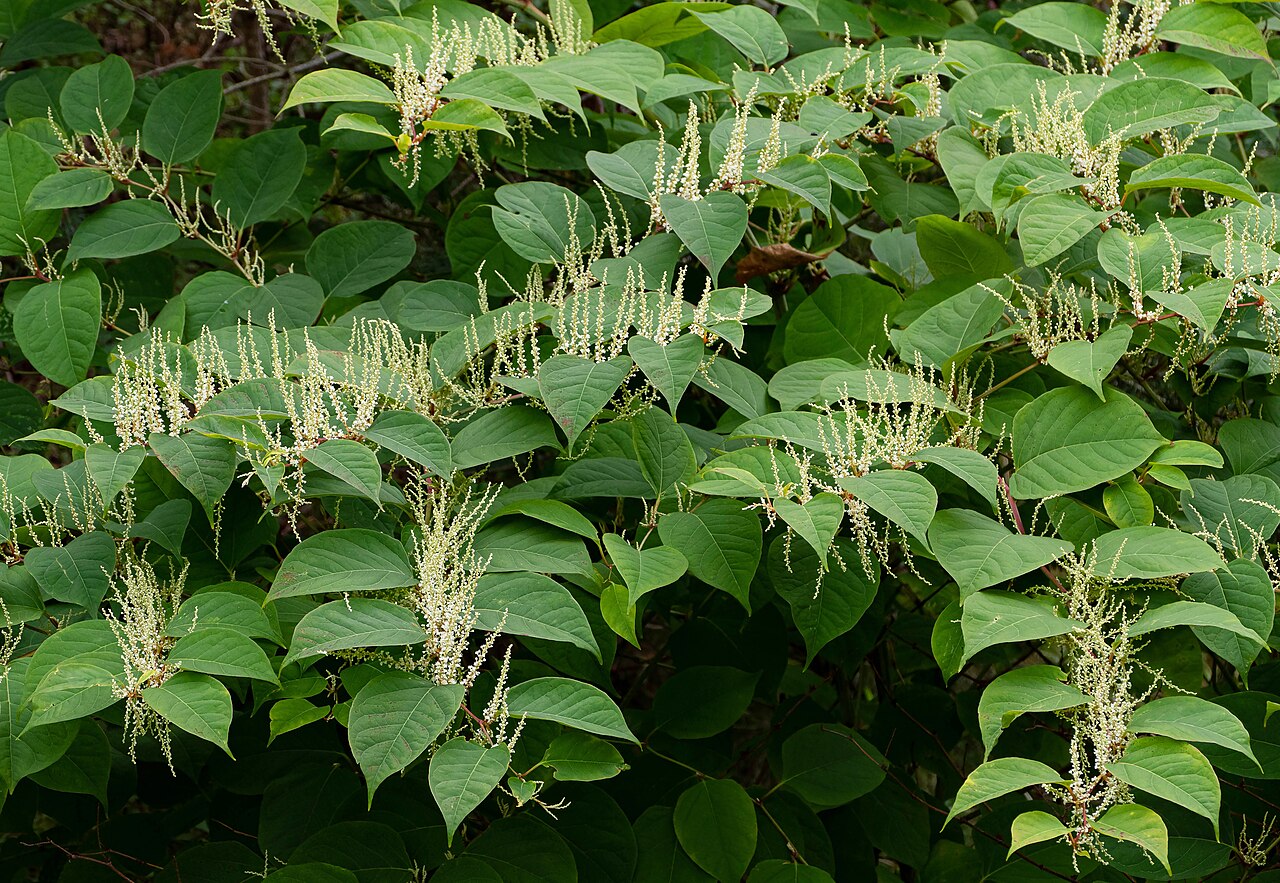
The stems are the fastest giveaway. They are hollow, jointed, and smooth, with reddish-purple mottling at the nodes, exactly like bamboo but softer. Mature canes run 1 to 1.5 inches in diameter. In early spring the emerging shoots are deep red-purple and look like asparagus crossed with rhubarb. By June they are fully leafed and towering. The leaves are shovel-shaped or broadly heart-shaped, 4 to 6 inches long by 3 to 5 inches wide, with a squared or slightly notched base rather than a pointed one. They alternate along the cane in a loose zigzag that gives a dense colony a tropical, layered look.
Late summer brings cream-white flower sprays, 3 to 4 inches long, erupting from the nodes in fingerlike clusters. The flowers are small, five-petaled, and lightly fragrant. After flowering, flat, winged seeds form, though most American spread happens vegetatively through rhizome fragments carried by water, equipment, or soil movement, not by seed. A rhizome piece the size of your thumbnail can establish a new colony. This is the fact that makes disposal so critical: never put cut stems or excavated roots in a compost bin or green-waste bin. Every piece goes into sealed heavy-duty contractor bags and to a landfill.
Structural impact is the reason this weed carries legal liability in the UK and rising concern in the US. The rhizome network exploits existing weaknesses in concrete, asphalt, and masonry. It does not drill through solid material, but once a hairline crack exists, root pressure widens it. Driveways, retaining walls, patios, and foundation footings are all vulnerable when a colony establishes within 10 feet. Near waterways the dense canopy shades out bank vegetation, destabilizes the soil once the canes die back each fall, and accelerates erosion. In riparian zones the spread is fastest because rhizome fragments travel downstream with flood events.